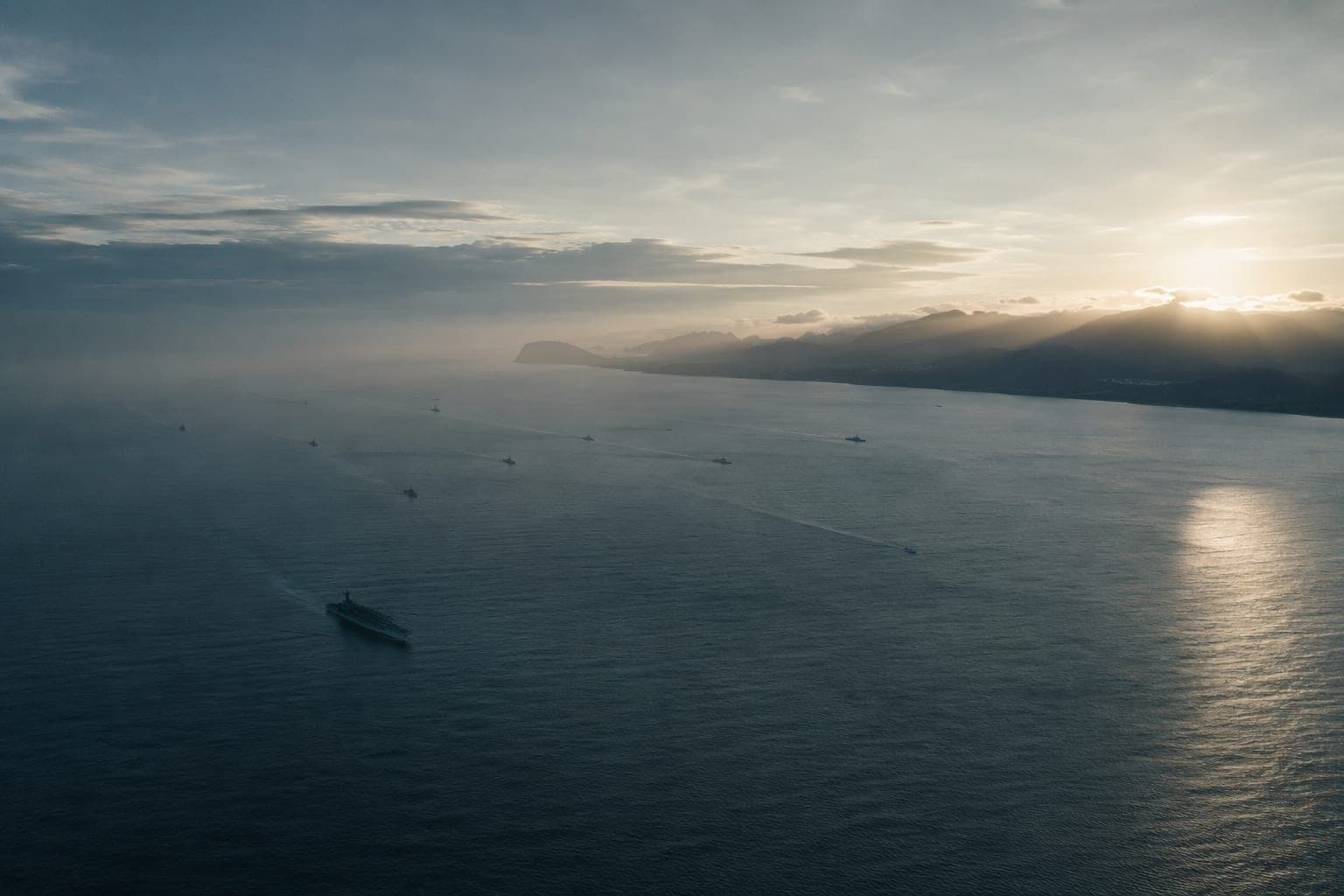
"A cross-strait crisis would not be a regional event. Through semiconductors, shipping lanes, and alliance commitments, Taiwan's security is embedded in the functioning of the global economy in ways that make any escalation a worldwide concern."
## Why Taiwan Is Different From Every Other Flashpoint Most geopolitical flashpoints affect specific regions or sectors. A Taiwan Strait crisis would affect everything. Taiwan's TSMC produces approximately 90 percent of the world's most advanced semiconductors, the components at the foundation of modern defense systems, consumer electronics, automotive manufacturing, and artificial intelligence infrastructure. No other single geographic location concentrates this much economically critical production. Beyond semiconductors, the Taiwan Strait is one of the world's busiest shipping lanes. Approximately $5 trillion in annual trade passes through the broader South China Sea corridor. A sustained naval standoff would force rerouting through the Lombok and Sunda Straits, adding days and significant cost to supply chains that span the globe. And beyond economics, Taiwan is an existential test of American alliance credibility in the Indo-Pacific.
If the United States chose not to respond to a Chinese use of force against Taiwan, the implications for Japan, South Korea, Australia, and the Philippines would be immediate and profound. The deterrence architecture of the Western Pacific would require fundamental reassessment. ## The Four Scenarios **Scenario One: Sustained Deterrence (Probability: 42%)** The baseline scenario is that the current deterrence equilibrium holds through 2026. China continues large-scale military exercises around Taiwan, conducts grey-zone pressure operations including airspace incursions and maritime harassment, and maintains its assertion of sovereignty, but does not move to blockade or invasion. This scenario is supported by the analysis of Chinese decision-making calculus. An invasion of Taiwan would require an amphibious operation across 100 miles of open water against a prepared defense, with a high probability of US intervention and near-certain economic isolation that would devastate China's export-dependent economy. The costs of failure would be existential for the Chinese Communist Party's legitimacy. Most serious analysts of Chinese decision-making conclude that Xi Jinping has not made a decision to use force, and that the preference remains for eventual unification through political rather than military means. **Scenario Two: Intensified Grey-Zone Pressure (Probability: 32%)** The second scenario involves a significant escalation of coercive measures short of armed conflict. This could include sustained disruption of undersea cables connecting Taiwan to global internet infrastructure, more aggressive naval patrols within Taiwan's exclusive economic zone, and economic pressure on companies with Taiwan exposure. This scenario is more probable than an invasion because it offers Beijing meaningful coercive leverage at much lower cost and risk. The challenge for Taiwan and its partners is that grey-zone actions occupy a space between normal competition and armed conflict where the appropriate response is genuinely difficult to determine. **Scenario Three: Naval Blockade (Probability: 18%)** A naval blockade of Taiwan would represent a fundamental escalation, effectively a use of force that would trigger US treaty obligations and almost certainly produce direct confrontation between US and Chinese naval forces. China would need to calculate that the United States would either stand down or accept a negotiated outcome on Chinese terms. The economic consequences of a blockade would be severe and immediate. Semiconductor shortages would emerge within weeks. Shipping insurance for the broader region would become prohibitively expensive or unavailable. Global equity markets would experience a correction of a magnitude comparable to the 2008 financial crisis or larger. **Scenario Four: Invasion (Probability: 8%)** A full invasion scenario, while assessed as low probability in the near term, is not dismissible. The People's Liberation Army has invested heavily in precisely the amphibious and joint operations capabilities that an invasion would require. Xi Jinping has publicly stated that unification is a historical inevitability and has linked it to the rejuvenation of the Chinese nation. The consequences of an invasion, regardless of its military outcome, would include the largest disruption to the global economy since World War Two. ## Investment and Policy Implications For investors with exposure to semiconductor supply chains, the relevant risk is not primarily the invasion scenario. It is the grey-zone escalation scenario, which could disrupt production without triggering a formal conflict. Companies that have announced diversification away from Taiwan-concentrated production, including TSMC's investments in Arizona and Japan, should be understood partly as geopolitical risk management rather than purely commercial decisions. For governments, the Taiwan question has accelerated industrial policy interventions in semiconductor manufacturing that would have been unthinkable five years ago. The US CHIPS Act, the European Chips Act, and Japan's substantial subsidies to domestic semiconductor investment all reflect a political judgment that the concentration of critical production in a single geopolitically contested location is a strategic vulnerability that market forces alone will not correct. ## The Deterrence Homework That Remains Undone The current deterrence framework rests on ambiguity: the United States has never formally committed to defending Taiwan militarily, relying instead on the Taiwan Relations Act and the associated posture. Several analysts argue that this ambiguity, which may have served stability in the past, is increasingly a source of miscalculation risk as Chinese capabilities grow and the gap between Chinese and Taiwanese conventional forces widens. The debate about whether to move toward strategic clarity, an explicit defense commitment, or to maintain ambiguity is one of the genuinely contested questions in American foreign policy. The answer has consequences that extend far beyond the Taiwan Strait.
Cite This Report
Institutional Citation Tool
Research & Analysis Q&A
What would a Taiwan crisis mean for semiconductor supply?
Taiwan produces approximately 90 percent of advanced semiconductors globally. Even a grey-zone escalation that disrupted TSMC operations for weeks would cause shortages across automotive, consumer electronics, and defense manufacturing sectors within months, with effects lasting years.
Is China preparing to invade Taiwan?
China has invested in the capabilities required for a cross-strait operation, but most credible analyses of Chinese decision-making conclude that the costs and risks of an invasion remain prohibitive. The more likely near-term pressure tool is grey-zone coercion rather than open military action.
How are companies responding to Taiwan risk?
Major semiconductor companies including TSMC have announced significant investments in production facilities outside Taiwan, in the United States, Japan, and Germany. These decisions reflect both commercial logic and a response to government incentives explicitly designed to reduce geopolitical concentration risk.